
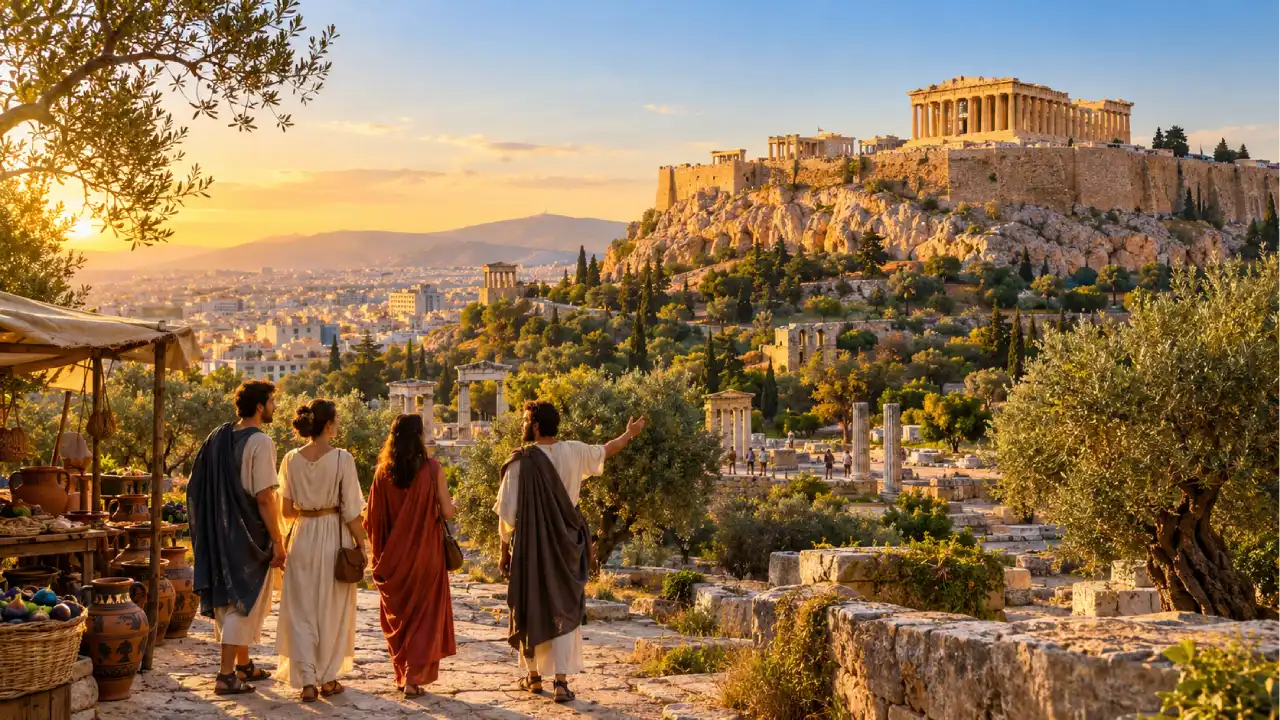
Walk Like an Ancient Athenian: How to Live the Athens a Traveler Would Have Known
Over 2,500 years ago, foreigners were already coming to Athens to see the Acropolis, meet philosophers and watch the festivals. Here is what that visit looked like, and how you can have a version of it today.
How Ancient Visitors Explored Athens
There were no guided buses or ticket booths. Still, travelers had their own ways of discovering the city.
Guides and storytellers. At sanctuaries and monuments, local exegetai explained the offerings, myths and rituals to visitors. Writers like Herodotus and Pausanias (2nd century AD) were the travel writers of their day. In his Attica, Pausanias walks readers through Athens route by route: the port, the Kerameikos cemetery, the Agora and the Acropolis.
Where they stayed. It depended on who you were.
- The wealthy or distinguished visitor stayed with a host family through xenia, the sacred bond of hospitality protected by Zeus Xenios. Others were looked after by a proxenos, an Athenian who represented their home city and considered it an honor. Some rented a house and hired attendants.
- The merchant or craftsman stayed at an inn near the port or the Agora and ate at taverns and food stalls.
- The sailor or poor traveler often slept on the ship or by the harbor in Piraeus, ate bread, olives, figs and fish, and saw whatever was free: the Agora, the streets, the processions and the festivals.
Our sources mostly describe the rich and famous, because they left written records. What we know about ordinary sailors comes indirectly, from inscriptions, comedies and archaeology.
What They Came to See
- The Acropolis: the Parthenon, the Propylaea, the Erechtheion and the giant bronze Athena Promachos
- The Ancient Agora: the Stoa Poikile, the Tholos, the Bouleuterion and the Temple of Hephaestus
- The Kerameikos cemetery, the Theatre of Dionysus and the Temple of Olympian Zeus
- The philosophers’ haunts: the Academy and the Lyceum
- The harbors of Piraeus
During big festivals like the Panathenaia, the Dionysia and the Eleusinian Mysteries, the city filled with visitors, and the processions and games became the “itinerary.”
Then vs. Now
| Ancient Athens | Athens today | |
|---|---|---|
| Stay | Xenia, a proxenos or an inn | Hotels, apartments and hostels for every budget |
| Guidance | Exegetai, later Pausanias | Licensed guides, audio guides and museum displays |
| Getting around | On foot or by ship | Metro, tram, taxi and, in the historic center, still on foot |
| Access | Open sanctuaries, with limits, no tickets | Ticketed sites with set hours and protected monuments |
| The monuments | New, painted and full of offerings | Ruins weathered white by time, some restored |
| The ordinary traveler | Festivals were the main spectacle | Discounted tickets, free-entry days and free walking routes |
How to Experience It Today
- Acropolis and the Acropolis Museum. The Parthenon and Propylaea still stand above the city. The museum shows the sculptures as they were meant to be seen, with a view of the rock.
- Ancient Agora and the Stoa of Attalos. This is the best place to feel everyday ancient life. The Temple of Hephaestus is remarkably well preserved, and the reconstructed Stoa works as a museum.
- Kerameikos. Ancient tombs and the Dipylon Gate, usually far from the crowds.
- Theatre of Dionysus and the Odeon of Herodes Atticus. The Odeon still hosts summer performances, a modern echo of the festival theatre.
- Piraeus. Walk by the ancient walls and the Zea shipsheds, then eat fish by the harbor, as an ancient sailor might have.
- Follow Pausanias. Many guides and books trace his route from the Kerameikos to the Acropolis.
- Festivals. Reenactments of the Panathenaic procession and the Athens & Epidaurus Festival keep the tradition alive.
Practical tip: there is a combined ticket for the main archaeological sites of Athens, but prices and conditions change, so check the official Hellenic Ministry of Culture website before you go.
Experience It Your Way, with Athens Cabs
The ancient visitor had a host, a guide and someone who knew the city. Today you can have the same thing. Athens Cabs is a licensed Greek company offering fully private travel with local professionals:
- Private tours of Athens and Greece, from short tours to day trips, built around your schedule and interests
- Licensed tour guides who can bring the Agora, the Acropolis and Pausanias’s Athens to life
- A private driver by the hour or by the day, so you can skip the logistics
- Airport and cruise terminal transfers, including combined transfer-and-tour days
- A GPS audio guide and free app for exploring at your own pace
- Day trips beyond Athens, such as Delphi, Ancient Olympia, Mycenae and Epidaurus, and Cape Sounion
Everything is arranged with real people, not bots, and no shared groups.


